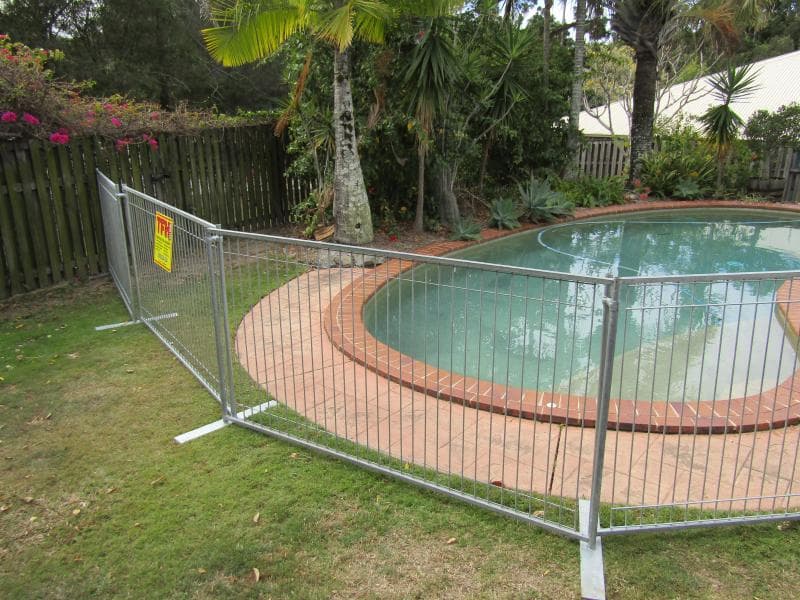
If you take one thing from this article, take this: standard temporary mesh fencing is not a pool barrier. It never has been, and installing it around a pool because a fence was needed and mesh was available is the most common serious error in this part of the industry.
Pool barriers exist to stop a small child reaching water unsupervised. That is a much harder engineering problem than keeping adults off a construction site, and it is governed by its own standard.
What a pool barrier has to do that a site fence does not
The applicable standard is AS 1926.1, and its requirements are specific because the failure mode is specific. A pool barrier must control:
- Height, measured from the finished ground on the outside of the barrier
- Gaps, at the bottom, between vertical members, and anywhere a small body could pass through
- The non-climbable zone, the area around the barrier that must be free of anything providing a foothold
- Gates, which must be self-closing and self-latching from every position, with a child-resistant latch at a controlled height, and must swing outward away from the pool
A construction perimeter has none of these constraints because it is solving a different problem. Site mesh has a large aperture, offers footholds, and a general-purpose self-closing gate is not built to a child-resistant standard.
The products that do comply
There is a dedicated product line for this application. Pool panels use a vertical bar profile designed to eliminate footholds, at the height and gap dimensions the standard requires. The matching temporary pool gate is self-closing and self-latching with a child-resistant latch.
They are hired as a pair. A compliant barrier with a non compliant gate is not a compliant barrier.
When you need a temporary pool barrier
Several situations come up regularly:
During construction of a new pool. The moment a pool shell can hold water, it is a hazard. That is usually well before the permanent barrier is installed, and the gap between those two dates is exactly when a temporary barrier is required.
During landscaping or renovation. Permanent barriers get removed for access to paving, decking or retaining work. The pool does not stop being a pool while that happens.
When a permanent barrier fails an inspection. A temporary compliant barrier keeps the property safe while remediation is arranged.
During a property sale or lease transition. Compliance obligations attach to the property, and a gap in the barrier is a gap in the obligation.
The non-climbable zone is what catches people
The requirement that gets missed most often is not height, it is what sits next to the barrier.
A compliant fence with a pot plant, a retaining wall, an air conditioning unit, a stack of pavers or a wheelie bin beside it is no longer a compliant barrier, because the child now has a step. On a construction or landscaping site this is a live issue, because materials move daily and get stacked wherever there is room.
The barrier needs a clear zone around it, and keeping that zone clear is an ongoing task rather than a day one check.
State law sits on top of the standard
The standard describes the barrier. State legislation makes it enforceable, and the detail differs. New South Wales operates under the Swimming Pools Act 1992 with a registration and certification regime. Queensland regulates through the pool safety provisions of its building legislation. Victoria, Western Australia, South Australia and the territories each have their own arrangements.
Requirements also differ for portable and inflatable pools above certain depths, which surprises a lot of homeowners. Check the rules that apply where the property is, and treat this article as general information rather than legal advice.
A short checklist
- Confirm whether a pool, spa or water feature falls inside the work area before the fencing is specified.
- Specify pool rated panels and a pool rated gate, not site mesh.
- Establish the non-climbable zone and keep it clear of materials, plant and equipment.
- Check the gate self closes and self latches from every position, not just from fully open.
- Re inspect whenever site conditions change or materials are stacked nearby.
- Confirm the barrier stays in place until the permanent barrier is complete and certified.
Getting the right barrier on site
If a pool falls inside your work area, the equipment decision is straightforward once the requirement is clear. Request a quote with the pool dimensions and your access needs, or get in touch.
More on the wider legal picture in our temporary fencing compliance guide, and on general perimeters in the temporary fencing FAQ.