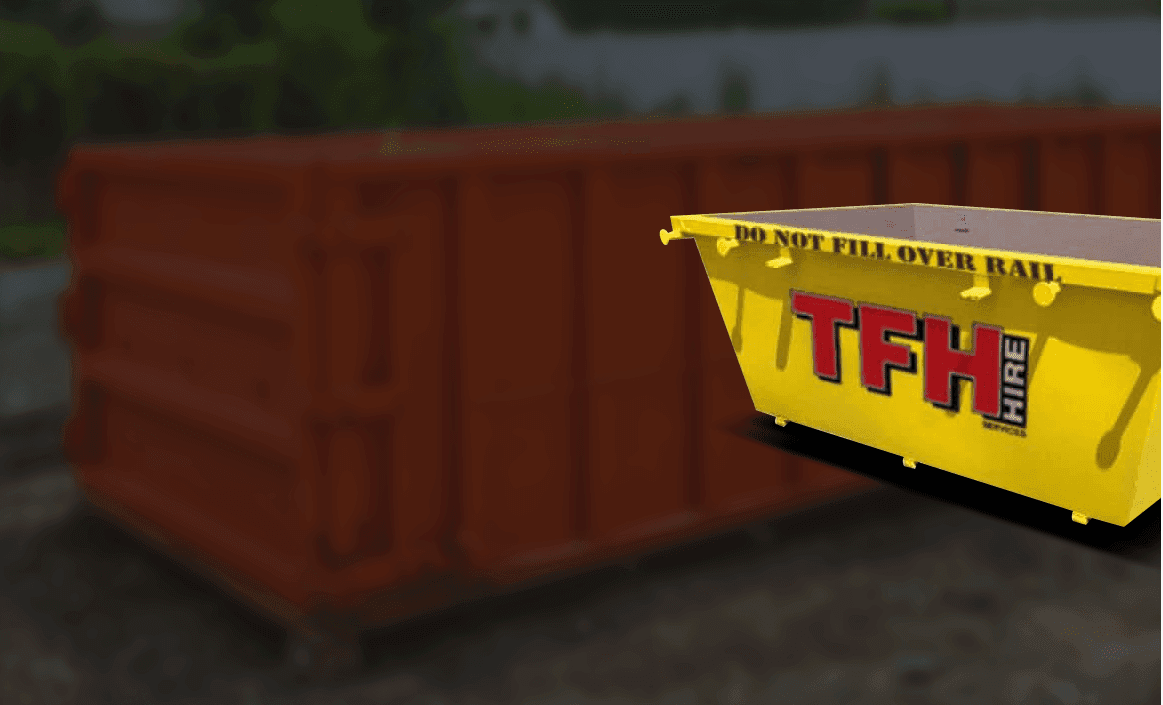
Waste is the least glamorous line on a site budget and one of the easiest to get wrong in both directions. Too little capacity and the site drowns in swap out fees and overflowing bins. Too much and you pay to hire air. The good news is that bin selection reduces to four questions.
Question one: how much waste, how fast?
Volume over time, not total volume, is the number that matters. A renovation producing 20 cubic metres over two days needs one large bin once. A workshop producing the same volume over three months needs a smaller bin on a swap out schedule.
The range maps to volume bands fairly cleanly:
- Wheelie bins at 240L for office, lunchroom and packaging waste
- Portable skip bins from 3m to 15m for general site and demolition waste
- Mobile skip bins at 4m where the bin needs to move or street placement matters
- Hook bins at 12m, 15m and 16m for bulk volume and heavy commercial use
Question two: what kind of waste?
Waste type constrains both the bin and the price, because disposal is priced by what is in it.
Mixed general waste is the default and the simplest. Clean fill, concrete and masonry are heavy: they hit weight limits long before they hit volume limits, so they suit smaller bins collected more often. Timber and green waste are bulky but light, the opposite profile. Metals are worth separating on any job producing volume, since mixed loads throw away the scrap value.
The absolute exclusions apply everywhere: asbestos, liquids, chemicals, batteries and gas bottles never go in a general bin. They have dedicated disposal routes, and finding them at the tip turns a routine collection into an expensive problem.
Question three: what can the site accept?
A hook bin needs a truck with clear overhead access and room to work. A standard skip needs a crane truck to reach the placement point. If the placement is an underground car park, a tight laneway or behind a height bar, the mobile skip on its trailer is usually the answer, and it is the one bin designed for the customer to reposition.
Surface matters too. Steel skids on a stencilled driveway are a reinstatement claim waiting to happen. Wheels or timber dunnage solve it, but only if the requirement is known at booking.
Question four: how long is the job?
Short hires want capacity up front: one bin, sized generously, collected once. Long hires want a rhythm: a bin sized to the weekly volume with a standing swap out schedule, plus a wheelie bin or two for the light stream so the skip is not consumed by cardboard.
For long duration sites it is also worth separating streams early. A general bin plus a dedicated metals bin usually costs less than the same volume mixed.
A worked example
A suburban house renovation, six weeks, driveway access only, no crane reach past the carport:
- One 4m mobile skip on the driveway for demolition and general waste, swapped as it fills
- A 240L wheelie bin for packaging and lunchroom waste
- A heavy waste plan for the concrete path being removed: small loads, collected separately
That setup costs less than one oversized fixed skip with a road permit, and nothing about it depends on a crane truck window.
Getting it specified
Describe the job, the waste, the access and the duration, and the right configuration usually falls out in one conversation. Request a quote or get in touch.
Related reading: mobile skip bins in detail and waste on non sewered sites.