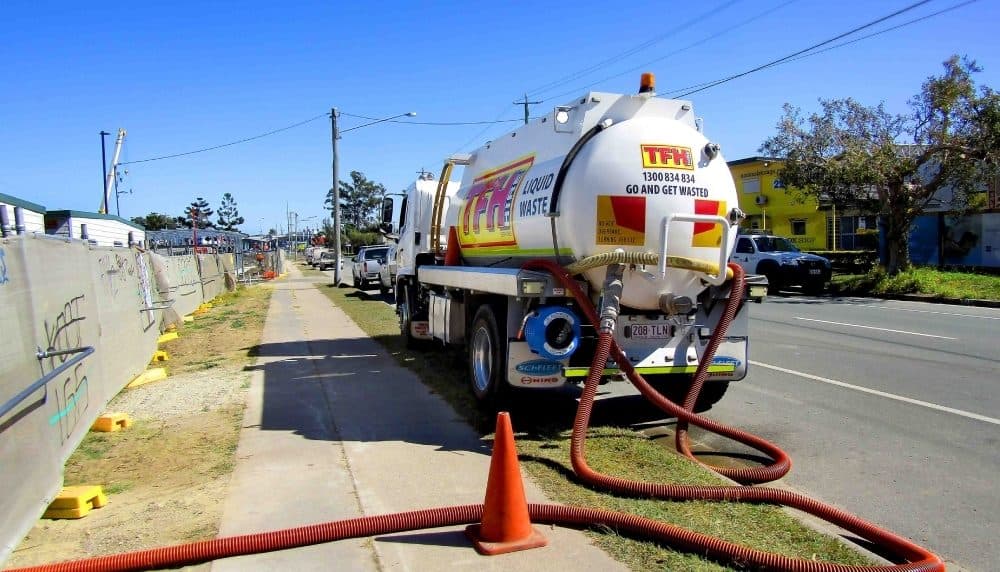
Plenty of Australian sites sit nowhere near a sewer: greenfield subdivisions, road corridors, rural builds, mine support areas, event sites in parkland. The facilities still have to work, and the workforce provisions still apply. What changes is the plumbing: everything the site produces has to be held, and everything held has to be pumped.
The two pieces of the system
A non sewered setup has exactly two components, and sizing them against each other is the whole game.
Holding capacity. Waste tanks in 2200L and 4400L sizes collect output from toilets, ablution blocks and wash stations. The tank is buffer storage: its size determines how long the site runs between services.
The pump out schedule. A waste pumping service empties the tanks on a cycle. Frequency is driven by headcount, facility count and tank size.
Undersize the tank and the schedule gets punishing. Underservice the schedule and the facilities shut down. Neither failure announces itself politely.
Sizing against headcount
The variables are straightforward: how many people, how many hours a day, how many facilities feeding the tank. A small crew on a single fresh water toilet sits comfortably on a 2200L tank with a routine schedule. A full ablution block with showers serving a large crew needs 4400L capacity, possibly more than one, and a materially tighter cycle.
Two sizing rules cover most errors:
- Size for peak occupancy, not average. Shutdown weeks do not offset pour days.
- Showers change everything. Grey water volume from showers dwarfs toilet output. If the site has shower facilities, size the tanks against water usage rather than headcount alone.
The mistakes that actually happen
The schedule set once and never revisited. Crew doubles during fit off, tank fills in half the time, and the first sign is a facility nobody can use. Any change in site headcount should trigger a schedule review.
Tanks placed for delivery convenience rather than truck access. A pump out truck needs to get a hose to the tank on every visit, in wet weather, after the site layout has changed. A tank that was reachable in week one and buried behind materials in week ten stops being serviceable.
No winter access plan. Rural and greenfield sites turn to mud. If the truck cannot reach the tank, the tank does not get pumped, and the countdown starts.
Assuming the toilet is the whole system. Hand wash stations and wash down points feed the same tanks. Count every fixture when sizing.
Events on unsewered ground
The same physics applies to events, compressed into a weekend. A festival site in parkland runs on exactly this setup: toilet banks, holding tanks, and a pump out plan that may need a mid event service for multi day shows. The difference is that an event cannot tolerate a facility outage at all, so capacity margins should be larger and the servicing plan agreed with the operator in advance. Our guide to portable sanitation for large events covers the event side in detail.
Setting up a non sewered site
The specification conversation needs four numbers: peak headcount, facility list, site duration, and truck access. With those, tank count and schedule fall out directly.
Request a quote with those details, or get in touch. Related reading: site toilets and hygiene obligations and choosing industrial waste bins for the solid waste side of the same site.