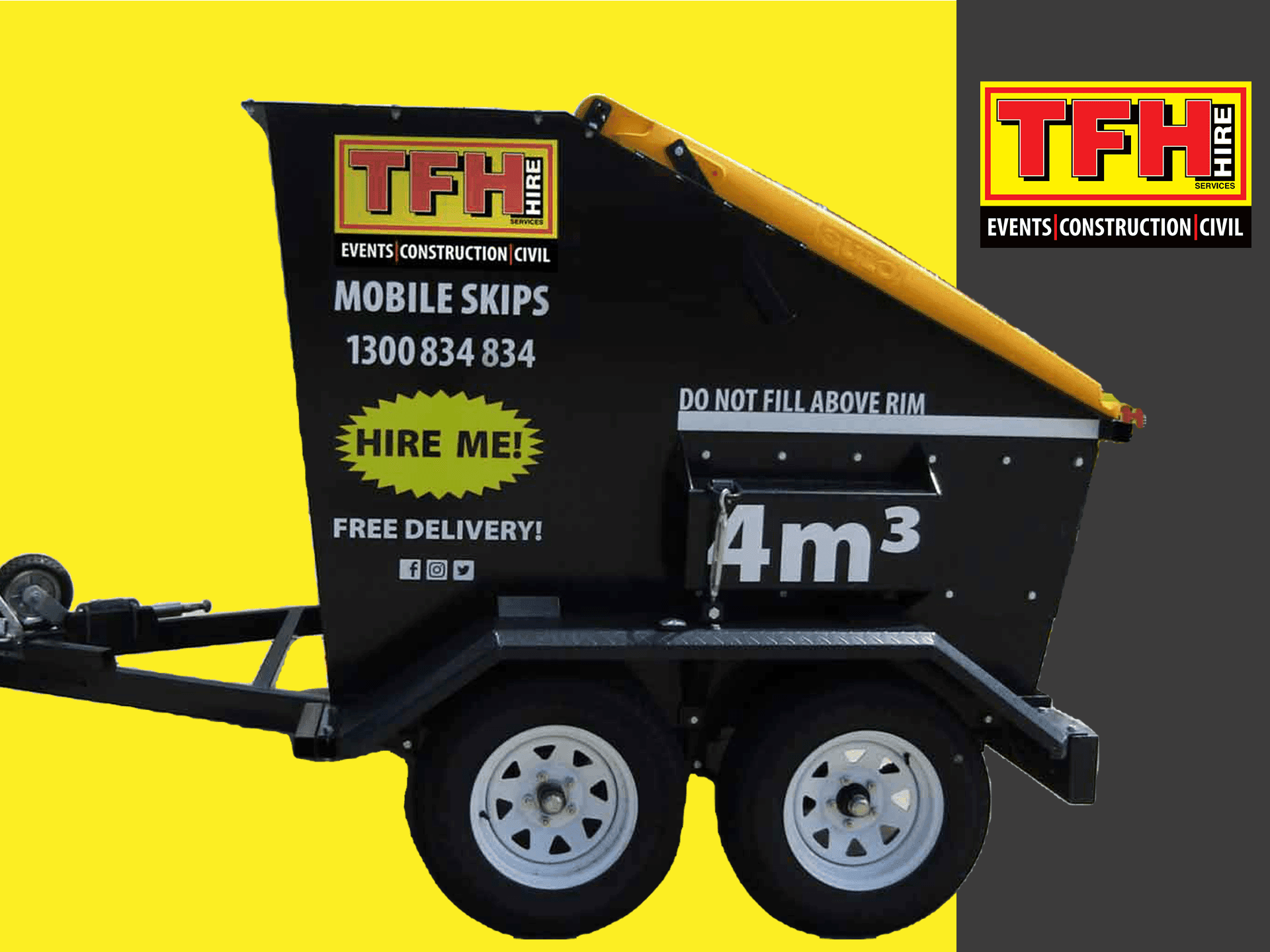
A conventional skip bin arrives on a truck, gets craned into position, and stays there until the truck comes back. For most sites that is fine. For a meaningful minority it is the single most annoying constraint on the job, and it is the reason mobile skip bins exist.
What makes a mobile skip different
A mobile skip bin is a fully enclosed bin on a registered trailer. That one design decision produces several practical consequences:
- It can be towed with a standard vehicle, so delivery and swap out do not depend on a crane truck's schedule or access requirements.
- On street placement is dramatically simpler. A trailer parked legally on a street is treated like a trailer, which in most council areas avoids the road occupancy permit a craned skip requires. For inner suburban renovations this is frequently the deciding factor.
- It protects the surface underneath. Wheels rather than steel skids means no crushed driveway, no gouged stencilled concrete, and no argument about reinstatement at the end of the hire.
- The bin is designed to be repositioned. This is the genuine exception to the rule that hire equipment stays where it is put. The mobile skip range is built to be towed and moved by the customer, and that mobility is the point of the product.
Where they earn their keep
Residential renovations. Tight driveways, no crane access, and councils that take road permits seriously. A mobile skip lands on the driveway or the street without triggering any of it.
Progressive works. A job that moves along a building, a strip of shops or a street benefits from waste capacity that moves with it rather than a fixed bin that gets further from the work each week.
Sites with restricted access. Underground car parks, height limited entries and narrow lanes that a crane truck cannot service.
Short, sharp cleanups. Deceased estates, office strip outs and garden clearances, where the whole job is a weekend and a truck window is half the cost.
When a conventional skip is still the right answer
Mobility trades against volume. For bulk demolition waste, concrete, or long duration sites producing steady volume, conventional skip bins in sizes from 3m up, or hook bins at 12m to 16m for serious volume, remain the right tool. A wheelie bin covers the office and lunchroom end of the same site.
The practical questions that decide it:
- Volume: more than a few cubic metres a week points to a fixed bin.
- Access: if a crane truck cannot reach the placement point, the decision is made for you.
- Placement: street placement without a permit is the mobile skip's home ground.
- Duration: long hires with steady waste suit scheduled swap outs of a fixed bin.
What goes in, what does not
Whatever the bin, the constraint that catches people is contents rather than capacity. Mixed general waste is straightforward. Concrete, bricks and soil are heavy enough that they change the transport equation. Asbestos, liquids, batteries and chemicals need dedicated disposal routes and must never go in a general bin. If in doubt, ask when booking rather than at collection.
Sizing it
The consistent mistake is hiring small to save money, then paying for extra collections. A bin that is slightly too big costs a little more once. A bin that is too small costs a swap out every time it fills. Estimate generously, especially for demolition and strip out waste, which is always bulkier than it looks in place.
Booking one
Tell us the job type, expected waste, placement location and duration, and we can steer between mobile and fixed options. Request a quote or get in touch.
Related reading: choosing the right industrial waste bin and waste management on non sewered sites.