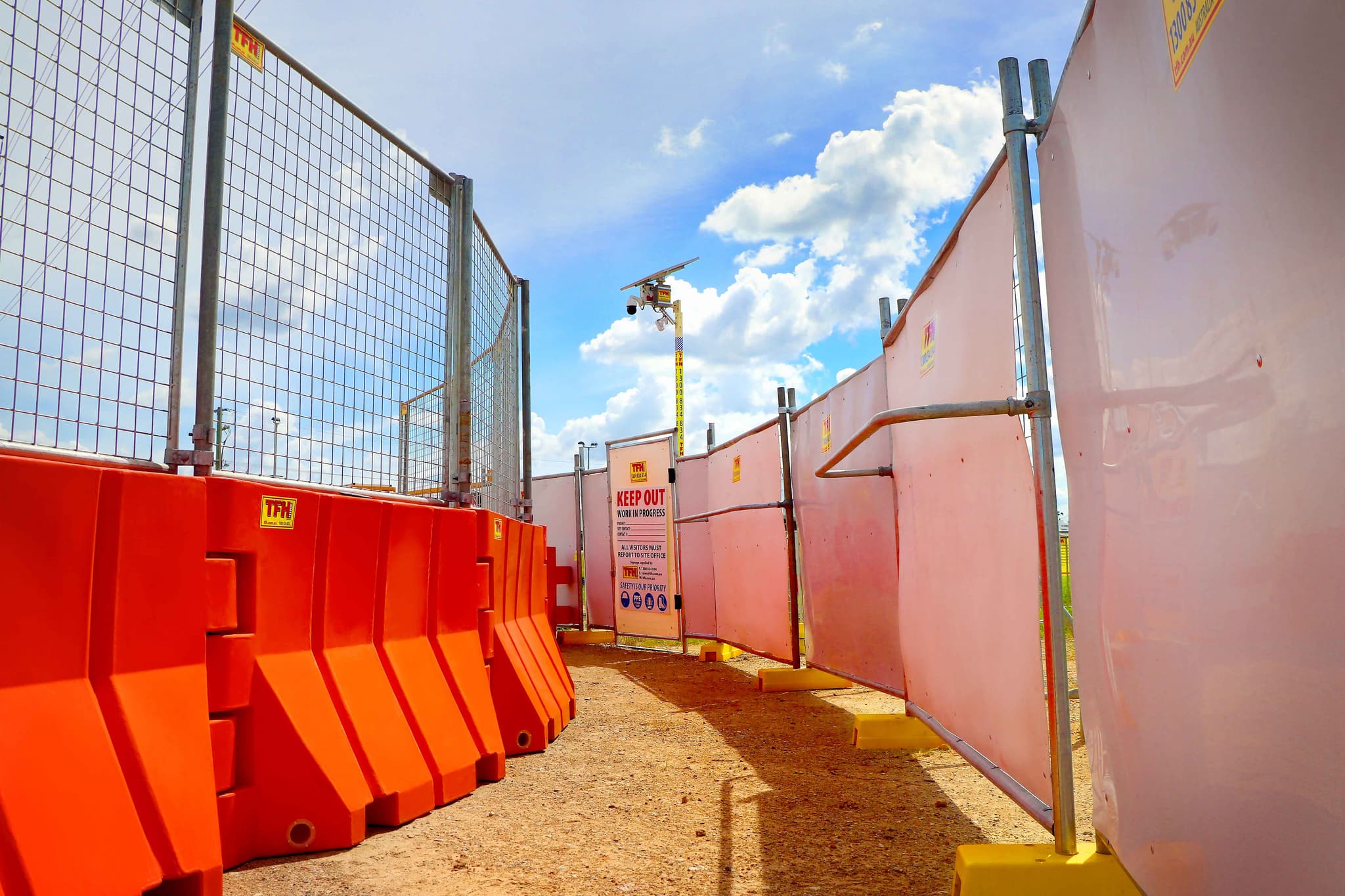
A temporary fence tells people where not to go. It does not stop anything with an engine. That distinction is the whole basis for choosing between a fence and a barrier, and getting it wrong is how a boundary that looked adequate on a plan fails in practice.
Mass versus marking
Barriers do one of two jobs.
Marking communicates a boundary. Mesh fencing, bunting and cones all do this. They work because people choose to respect them, which is entirely sufficient when the risk is a pedestrian wandering into a work area.
Containing physically resists something. This requires mass, and it is what you need when the consequence of the boundary being crossed involves a vehicle, either one leaving the road or one leaving the work area.
Most site incidents involving boundaries come from using a marking device where a containing device was required.
How water filled barriers work
Pedestrian water barriers arrive empty and are filled on site. That combination is the point: they are light enough to position while empty, and heavy enough to matter once filled.
Practical characteristics worth knowing:
- They interlock, forming a continuous run rather than a line of separate objects. A connected run distributes force rather than concentrating it on one unit.
- They are highly visible, in colours that read as a boundary at a distance and at night.
- They are stable at height when extended. Water barrier mesh extensions and hoarding extensions sit on top of the barrier, adding a fence height boundary on a base with real weight. This is often the right answer where a plain fence would be stepped over and a plain barrier would be walked around.
The most common use is separating pedestrians from live traffic, or protecting a work zone that sits alongside a trafficked area.
Where a longitudinal barrier is the right call
Roadside work with vehicles at speed is a different problem again. Ricochet barriers and the ricochet longitudinal barrier are built for that application, providing a hard longitudinal edge along a work zone rather than a pedestrian separation.
The decision between water barriers and a longitudinal barrier comes down to what you are protecting against: a person stepping in the wrong direction, or a vehicle leaving its lane.
Delineation is what makes the barrier work
A barrier without approach warning is a hazard that arrives suddenly. The equipment around it does the communication work.
- Reflective traffic cones taper traffic and mark transitions, with reflective sleeves that keep working at night.
- Portable arrow boards give directional instruction at a distance, well before the driver reaches the taper.
- Banner mesh on the run screens the work and carries site messaging.
The sequence matters more than the individual items: a driver should understand what is happening, then be guided, then reach the barrier. A barrier encountered without warning has already failed.
Choosing between the options
- Pedestrians near a work area, no vehicles: mesh fencing is adequate
- Pedestrians separated from vehicle movements: water barriers, extended if height is needed
- Work zone alongside a trafficked road: water barriers with proper delineation, or a longitudinal barrier where speeds warrant it
- Lane closures and traffic tapers: cones and arrow boards, backed by barriers where the work zone edge needs protection
- Overnight or low light work: everything above, with reflective and illuminated equipment
Getting the specification right
The equipment choice follows from the risk, and the risk assessment is the part worth spending time on. If you can describe the site, the traffic, and what is being protected, the equipment list follows quickly.
Request a quote with those details, or get in touch. More on the wider topic in why traffic management matters and ricochet road barriers.