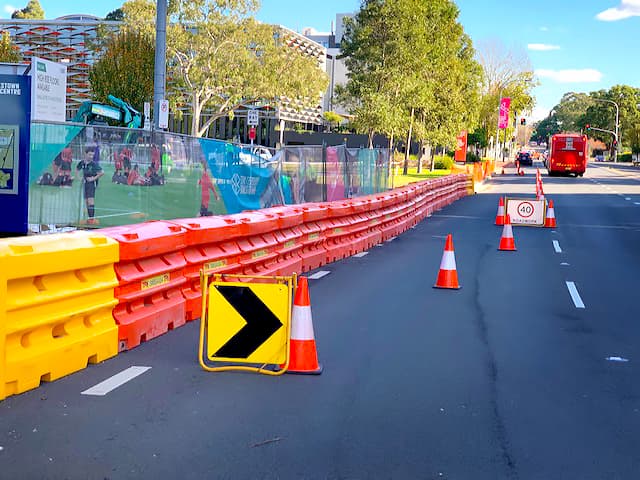
Every roadside work zone runs the same quiet calculation: what happens if a vehicle does not follow the cones? For most low speed environments, the answer is acceptable. Above certain speeds and exposures, it is not, and that is the point at which delineation gives way to barrier protection.
Delineation versus containment
The distinction is worth stating plainly, because it drives every equipment decision on a road job.
Delineation communicates. Cones, signage and arrow boards tell a driver what to do, and nearly all drivers do it. Delineation has no opinion about the ones who do not.
Containment physically responds. A longitudinal barrier along the work zone edge is there for the vehicle that drifts, whether through distraction, fatigue, or a swerve that started somewhere else. It exists to redirect the errant vehicle along the barrier line rather than into the work area.
How the ricochet system works
Ricochet barriers and the ricochet longitudinal barrier form a continuous connected run along the work zone edge. The operative word is connected: individual segments joined into a system behave as a single long mass that absorbs and redirects impact energy along its length, which is what stops a vehicle penetrating the line.
Practical properties that matter on the ground:
- Modular deployment. Runs assemble to the length the job needs and reconfigure as the work zone moves.
- Highly visible faces, doing delineation duty at the same time as containment.
- Designed transitions. The ends of a barrier run and the openings for site access are engineered details, not gaps left where convenient.
Deciding when a barrier is warranted
The formal answer lives in the traffic management plan, which for public road works is prepared under the relevant state scheme by accredited people. But the factors the assessment weighs are intuitive:
- Speed environment. The faster the passing traffic, the less forgiving the consequence of a drift.
- Duration and exposure. A crew beside a live lane for months accumulates more exposure than an hour's mobile works.
- Separation distance. Work happening at the lane edge has no buffer; work set well back may not need containment.
- What is behind the line. People and occupied plant justify more than stockpiled material.
When the assessment lands on containment, the barrier is the plan's requirement, and the hire equipment exists to satisfy it.
The pedestrian side of a road job
Road work zones are also pedestrian diversions, and the same errant vehicle logic applies to the temporary footpath. Where a diverted path runs beside live traffic, water filled pedestrian barriers provide the mass between path and lane, with extensions where height is needed. The wider pedestrian and internal site picture is covered in the importance of traffic management.
Ordering barrier equipment
Barrier runs are specified from the traffic management plan: length, transitions, access openings and the delineation package around them. Send the plan through with a quote request, or get in touch and we can work through the equipment list.
Related reading: water barriers and traffic equipment.