Strip away the paperwork and traffic management is one idea: vehicles and people should never be surprised by each other. Every plan, cone, barrier and board exists to remove surprise, to make what happens next obvious to a driver and a pedestrian at the same moment.
The stakes justify the effort. Vehicle interactions with pedestrians and workers are consistently among the highest consequence incidents on Australian work sites, and the site does not have to be big for the physics to be unforgiving. A ute reversing past a blind stack of pallets is the same hazard on a house block as on a highway job.
The three separations
Every traffic management setup is making three separations at once.
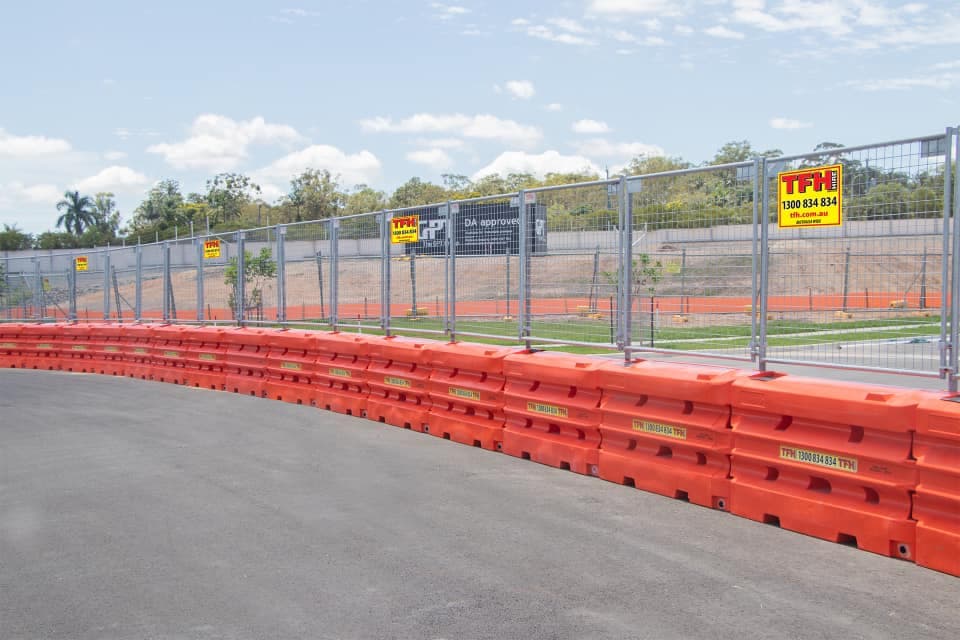
Public traffic from the work zone. Where a site touches a road, passing drivers need to understand the changed conditions early: signage and arrow boards for the announcement, reflective cones for the taper, and where the exposure justifies mass, water barriers or ricochet barriers as the hard edge. Works on public roads generally require accredited traffic management and a compliant plan; the equipment supports the plan rather than replacing it.
Pedestrians from everything. The public does not stop walking because a site opened. A compliant pedestrian route is continuous, barriered, lit and passable by a pram and a wheelchair, and it never quietly evaporates into a traffic lane. Diverting pedestrians into live traffic without protection is the finding that shuts sites.
Vehicles from people inside the site. The internal version gets less attention and produces plenty of the injuries: reversing plant, delivery vehicles and workers on foot in the same yard. Marked routes, exclusion zones around plant, a designated delivery area, and physical separation at the choke points do the work. Crowd control barriers handle the light duty internal separations; the fence line itself, covered in our perimeter guide, defines the outer boundary.
What a plan actually contains
For anything beyond a trivial site, the traffic arrangement should exist on paper:
- The routes: where vehicles enter, travel, turn around and leave, and where pedestrians go instead
- The controls at each conflict point: what physically or visually separates the flows where they approach each other
- The night and weather configuration: reflective equipment, lighting, and what changes when visibility drops
- Who maintains it: barriers get moved for deliveries; someone must own putting them back
- The trigger points for review: a new stage, a new gate or a new neighbour changes the plan
Equipment as a system
No single item manages traffic. The setup works as a sequence the driver experiences in order: warning, guidance, then barrier. A cone taper without approach warning is a swerve. A barrier without a taper is an impact. The full equipment logic is covered in water barriers and traffic equipment and ricochet road barriers.
Getting a site assessed
Describe the site, the vehicle movements and where the public touches the boundary, and the equipment list follows. Request a quote or get in touch.