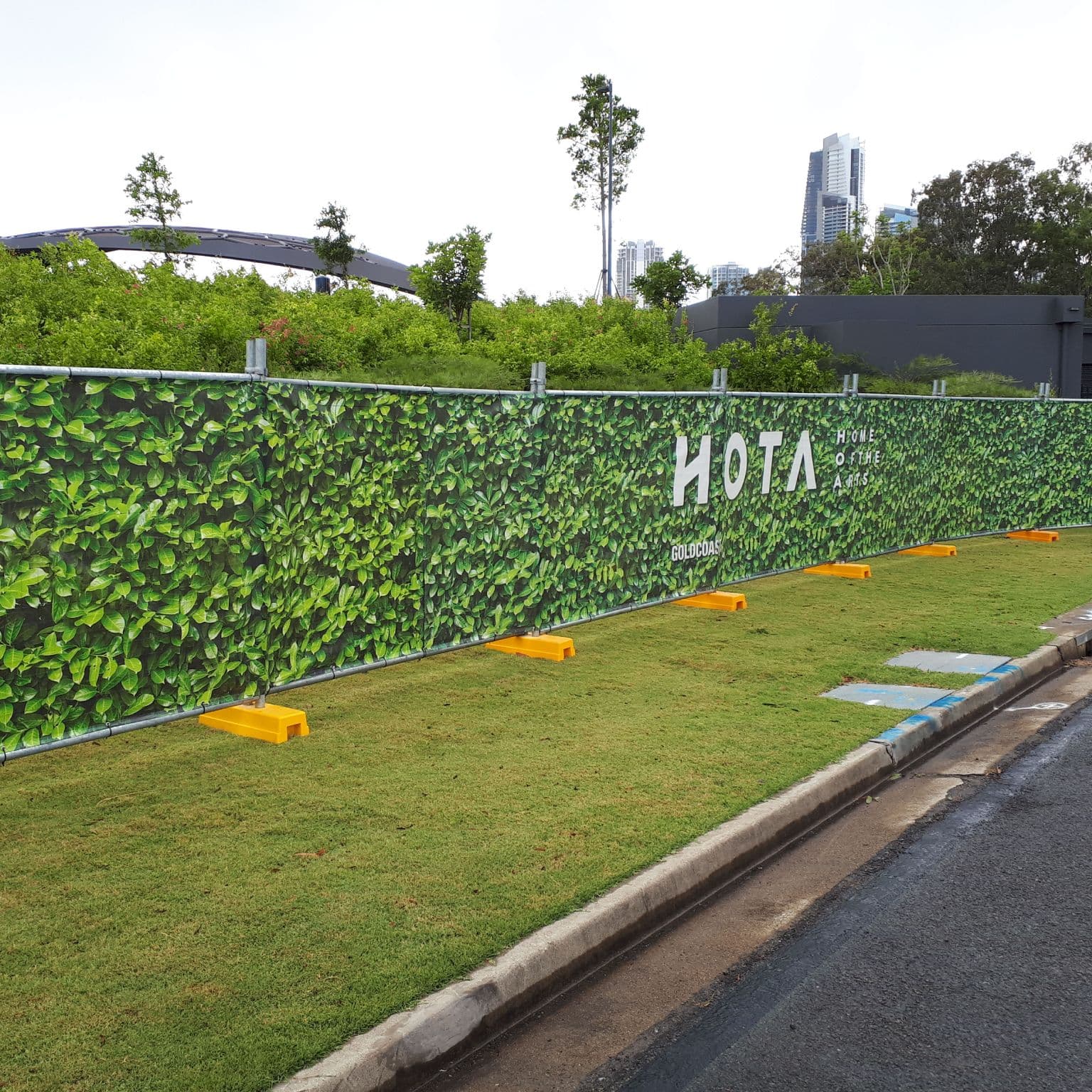
Home of the Arts, better known as HOTA, is the Gold Coast's cultural precinct at Bundall. It covers roughly 16.9 hectares and was delivered in stages, with a gallery, outdoor stage, parklands and a green bridge linking the site across to Chevron Island. TFH Hire Services worked with builder Hansen Yuncken on the expansion, supplying mesh fencing, water barriers, crowd control panels and barrier extensions across the site.
The interesting part of a project like HOTA is not the volume of fence. It is that the precinct stayed open while it was being built.
Building on a site that never closes
A conventional construction site has one perimeter and one job for it: keep the public out. A live cultural precinct has neither. People are attending performances, walking dogs through the parkland and arriving for events on the same land that has excavations, cranes and delivery traffic on it.
That changes the fencing problem in three ways:
- The boundary moves constantly. Each stage opens a new work area and hands a finished one back to the public. The perimeter is not installed once, it is re-cut repeatedly.
- Two audiences use the same ground. A worker knows what a barrier means. A family arriving for an outdoor concert does not, and will not read a sign before walking around one.
- The fence is visible. On a hidden industrial site, appearance is irrelevant. On a cultural precinct with paying visitors, a shabby perimeter is a problem for the client.
Matching the barrier to the boundary
Different edges of a site like this need genuinely different equipment, which is why the supply covered several product lines rather than one.
Mesh fencing handles general work area perimeters, where visibility is useful and the risk is people wandering in rather than vehicles running off.
Pedestrian water barriers do the job mesh cannot: they bring mass. Where a boundary separates public foot traffic from vehicle movements or a live traffic edge, a barrier that resists impact rather than simply marking a line is the correct control. Barrier extensions add height on top of that mass where a low barrier alone would not stop someone stepping over.
Crowd control barriers suit the event side of the precinct, where the requirement is queue management and directing large numbers of people, and where the layout changes between events.
What large staged projects need from a supplier
The equipment list matters less than the ability to keep changing it. On a multi-year, multi stage build, the useful qualities are:
- Fleet depth, so a stage change does not wait on stock.
- Consistency of product, so panels installed in stage four still clamp to panels installed in stage one.
- Responsiveness to reconfiguration, because staged handovers rarely land exactly when the programme said they would.
- Reinstatement discipline, since a perimeter opened for a delivery and left open is the most common failure on any long job.
The public interface is the hard part
On a project that stays open, the fence is doing communication work as well as physical work. A visitor needs to understand at a glance which route is theirs, and the barrier has to make the wrong route obviously wrong rather than merely discouraged.
That is where banner mesh earns its place. Attached to the run it screens the work, carries wayfinding and project information at a readable scale, and turns a bare industrial perimeter into something that belongs in a cultural precinct. It also adds wind load, so bracing and ballast need to be specified with the sheeting rather than after it.
Applying this to your own project
Very few projects are the size of HOTA, but the pattern repeats at every scale: any site where the public keeps using part of the land while work continues on the rest. Schools during term, shopping centres mid refurbishment, sportsgrounds with a clubhouse rebuild, councils upgrading a park.
If that describes your project, the conversation worth having early is about how the perimeter will change over time, not just what it looks like on day one. Request a quote with your staging plan, or get in touch to talk it through. You can also read about fencing for local community projects and securing large events.