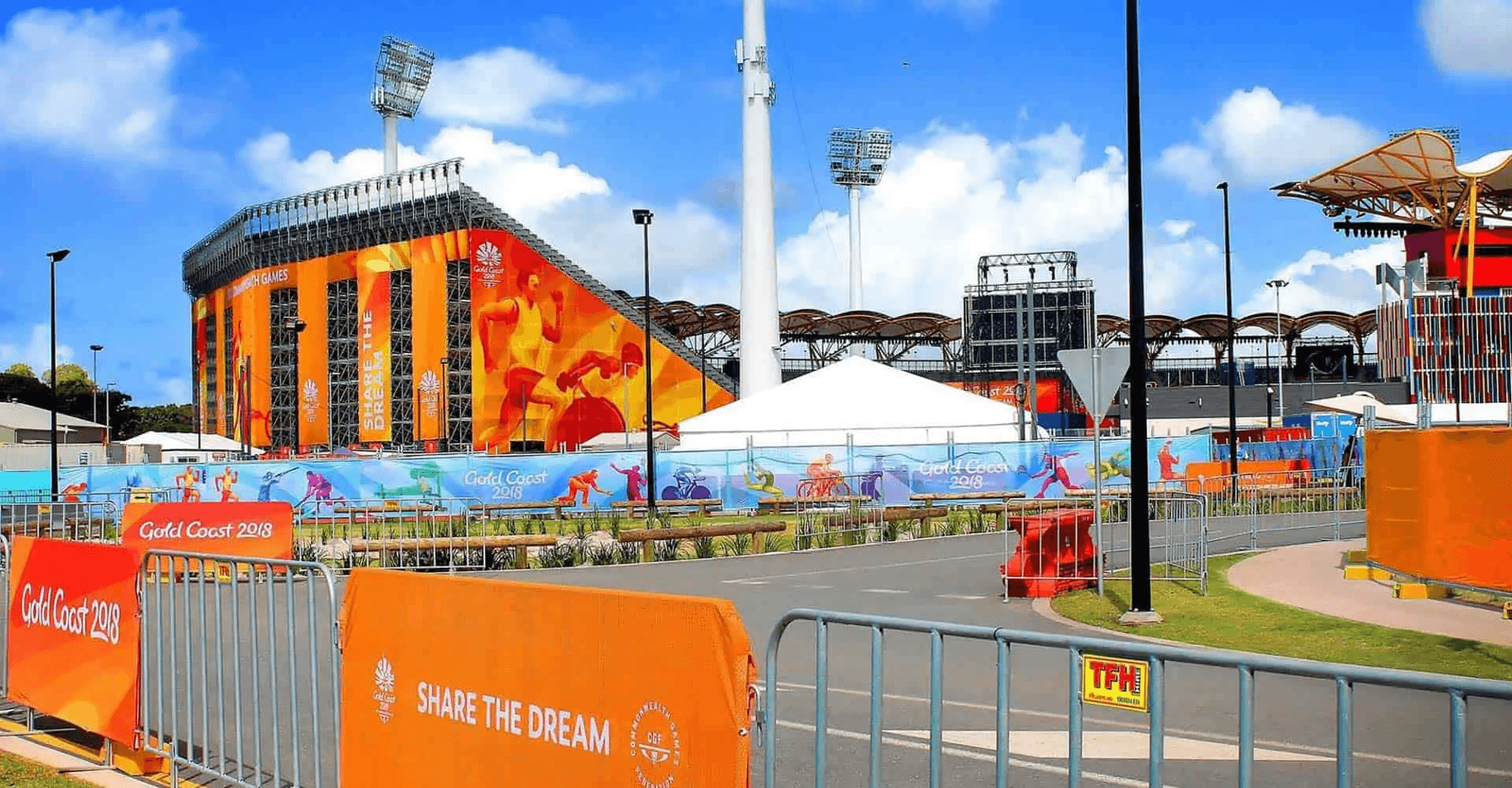
In September 2017 the Gold Coast 2018 Commonwealth Games Corporation, GOLDOC, appointed TFH Hire Services as the Games Official Supplier of Security Fencing. The scope ran to almost 22,000 metres of perimeter and security fencing supporting the delivery of Games overlay.
For a business that started in a backyard shed in Logan, supplying the largest event in Queensland's history was a reasonable measure of how far the operation had come.
What GOLDOC said
GOLDOC General Manager, Commercial, Cameron Murray, put it plainly at the time: "It is great to see local businesses, in this case a family business like TFH, getting on board to support the largest event in Queensland's history."
TFH founder Owen Thomas noted that the company had been headquartered in Logan for more than twenty years, with forty branches nationally at that point including four in South East Queensland, and more than five hundred staff. "Over the years, TFH Hire has been involved in many exciting and unique events although we recognise GC2018 as the most prestigious to date."
Why 22,000 metres is a different problem to 2,000
A major Games is not one venue. It is a distributed footprint of competition venues, training sites, transport hubs, live sites and back of house compounds, each with its own perimeter, its own access control and its own build and strike window.
The difficulty scales in ways that are not obvious:
- Everything happens at once. Venues do not build sequentially. Multiple sites need equipment delivered, set out and signed off inside the same narrow window.
- The specification has to be identical everywhere. Panels from one venue must clamp to panels from another, because equipment gets moved between sites during the event as areas change function.
- Strike is as time critical as build. Venues revert to public use on a published schedule. Fencing that stays up past its date is a visible failure.
- Security fencing is security infrastructure. At a Games, the perimeter is part of the accreditation and access control regime, not just a boundary marker.
Fleet depth is the actual capability
Any supplier can quote 22,000 metres. Delivering it, across a distributed footprint, on a fixed date, with no option to be late, is a different proposition. It depends on how much stock exists, where it is, and whether it can be manufactured rather than sourced.
TFH manufactures the large majority of its own product in Australia, which is what makes a commitment at that scale credible. It removes the import lead time from the critical path and means specification is controlled rather than requested.
The lesson for events that are not the Commonwealth Games
Most events are not Games scale, but the constraints rhyme. Fixed dates that cannot move, a build window that is always shorter than anyone wanted, a strike deadline with a penalty attached, and a perimeter that has to work for both crowd management and security.
The planning questions are the same at any size:
- How many separate perimeters are there, and does each one need a different product?
- Where does the public interface with the boundary, and is a visual barrier enough there or is mass required?
- What is the actual build window, and does it allow for the site not being ready on time?
- Who is responsible for reinstating the perimeter after each delivery or access event?
Planning an event perimeter
If you are working on an event with a fixed date and a real perimeter requirement, the earlier the layout conversation happens the better, because availability on peak weekends is finite. Request a quote with your site plan and dates, or get in touch.
You can also read our guides to choosing the right temporary fencing for your event, securing festivals and crowd control barrier hire.